

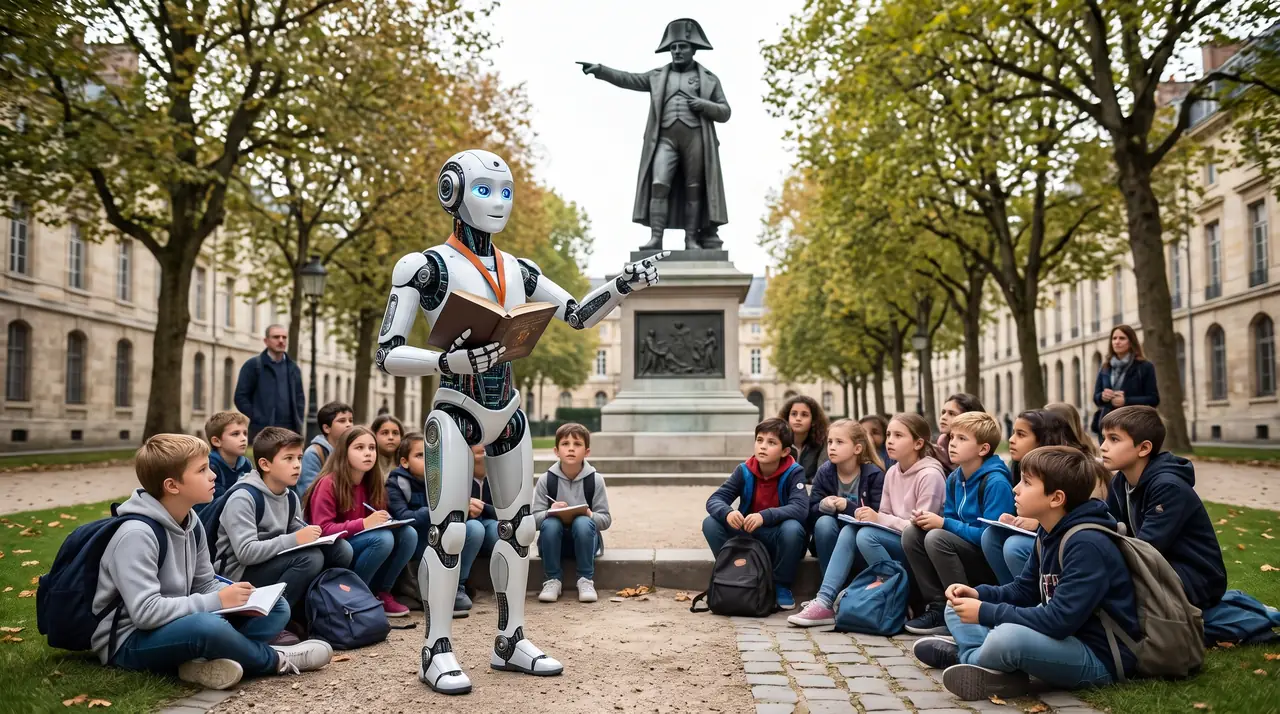
- All heritage is a message: time pulls it away from the intention of its author.
- A conversational AI can give it a voice again: empathy is born in the visitor, not in the machine.
- The venue is the guardian of its heritage, HistoVox the tool that conveys it, with sources, a role held and transparency.
Time passes, and distance sets in
The Second World War ended a little over eighty years ago: barely a human lifetime. Yet for the youngest generations it has become a textbook chapter, almost an abstraction. Those born in the 1970s grew up among people who had lived through it; they had heard their voices.
What recedes is not just a date. It is a psychological distance. The more time passes, the harder it becomes to imagine that those who lived through these events felt the same things we do: fear, hunger, hope, stubbornness. The last direct witnesses are disappearing one by one, and with them a way of telling the story that archives only partly preserve.
How do we make the humanity of those moments felt?
The facts are not in short supply: dates, figures, maps, textbooks. What gets lost is the reality of what men and women went through: what it felt like to be there. Making that tangible is the reason HistoVox exists.
What we do not feel, we eventually stop truly imagining.
All heritage is a message
We defend a simple idea: for us, all heritage is intangible. A building, a work of art, a text, an achievement are only the messages of their authors, whether they are architects, artists, craftspeople or participants in an event. The stone remains; the intention fades.
The 2003 UNESCO Convention defines intangible cultural heritage as the "practices, representations, expressions, knowledge, skills", together with "the instruments, objects, artefacts and cultural spaces associated therewith". Even in this definition, the object is never alone: it carries something that is passed on. We take that logic all the way.
Going furtherUNESCO Convention for the Safeguarding of the Intangible Cultural HeritageThe official text, including Article 2, which defines this heritage.ich.unesco.org ↗Time, however, pulls the message we read away from the intention of the person who wrote it. Culture changes, and so do its codes. Faced with a craftsman's tool in a display case, we see an object; we no longer see the gesture, the pride of a trade, or what that craftsman wanted us to remember. We read the past with our own eyes and references, and we risk hearing something other than what was meant for us.
Giving the floor back to the one who meant something
To make this message real and present, it has to be brought back to life: the author, the participant, the craftsperson explaining for themselves what they meant to pass on. For a long time, that was impossible. Conversational AI changes this.
It resurrects no one. It lets a character, built from what the sources establish about the intention of the person it portrays, answer the visitor live, in their own language. No answer is prerecorded: the visitor no longer reads a panel, they ask questions. The character brings the conversation back to the intention, describes it, and places it in its time.
This is how empathy is born: the visitor puts themselves in the place of the person who built, wrote, created or lived. Let us be precise: AI feels nothing; it is the visitor who feels. It is only a go-between.
Guardians, and a tool
This heritage has guardians: the museums, local authorities and companies that shelter it and keep it alive. They hold the documents, the archives, the stories, and they decide what their heritage says to the public. HistoVox is only the tool through which they pass it on to their visitors: a QR code, the visitor's phone, and a spoken conversation, in French, English or German depending on the character. We work with venues that have made this choice, and we build each character with them.
What we commit to
An AI that speaks about history can betray it in three ways: by inventing, by smoothing over, by deceiving about its nature. Our three requirements answer these three failings.
- Sources. Against invention, what is called a "hallucination": a plausible but false answer. The character says only what the venue's documents and historians' work allow us to establish. No system is infallible: that is why we test the answers before going live, and why the venue keeps control over what its character knows and how it says it.
- A role held. Against smoothing over. The character stays in its role, with the outlook of its time, without polishing it to make it comfortable.
- Transparency. Against deception. The visitor knows they are talking to an AI: the welcome screen says so clearly before the first question. The character itself does not say so unprompted, so as not to break the experience, and the welcome screen explains why.
It is also now an obligation. Since 2 August 2026, Article 50 of the European regulation on artificial intelligence requires people to be informed that they are interacting with an AI system, unless this is obvious to a reasonably well-informed, observant and circumspect person. The information must be given clearly, at the latest at the time of the first interaction. This paragraph is not legal advice; the official text can be consulted below.
Going furtherRegulation (EU) 2024/1689 on artificial intelligenceThe official text, including Article 50 on transparency.eur-lex.europa.eu ↗So, is AI a good vehicle for humanity?
It is not human, and it must not pretend to be. The humanity of a story is not found in the machine: it is in the work of historians, in the memory the guardians have preserved, in the words of those who lived it, and in the curiosity of the visitor who asks a question.
Memory is not an archive repository. It is a relationship between the living and those who are no longer here, and it fades the day nobody asks them questions any more. We believe conversational AI can reopen that relationship, provided it is an honest go-between, never a forger. We believe in it enough to have made it our profession.
Those who built, wrote, created and lived had something to tell us. We want the question to be able to be put to them.
Frequently asked questions
Who decides what a character says?
The venue, guardian of its heritage, provides the documents and keeps control over what its character knows and how it says it. HistoVox is the tool that passes it on.
Can an AI be wrong about history?
Yes, like any system. That is why a character's knowledge is limited to the documents the venue entrusts to it, its answers are tested before going live, and the venue keeps control.
Does a character speak in place of a real person?
No: a character is a role built from documents. It conveys what the sources establish about the intention of the person it portrays, but what it says is not a quotation from that person. The welcome screen also reminds visitors that they are talking to an artificial intelligence.
Do visitors have to be told they are talking to an AI?
Yes. The European regulation has required it since 2 August 2026, unless it is obvious. At HistoVox, the welcome screen says so before the first question.
He designs the characters and supports the venues that host them. All his articles
Text written with the help of AI, reviewed and approved by its author. The audio is a synthetic voice.